A net-worth logbook

How long can you afford to live life on your terms?

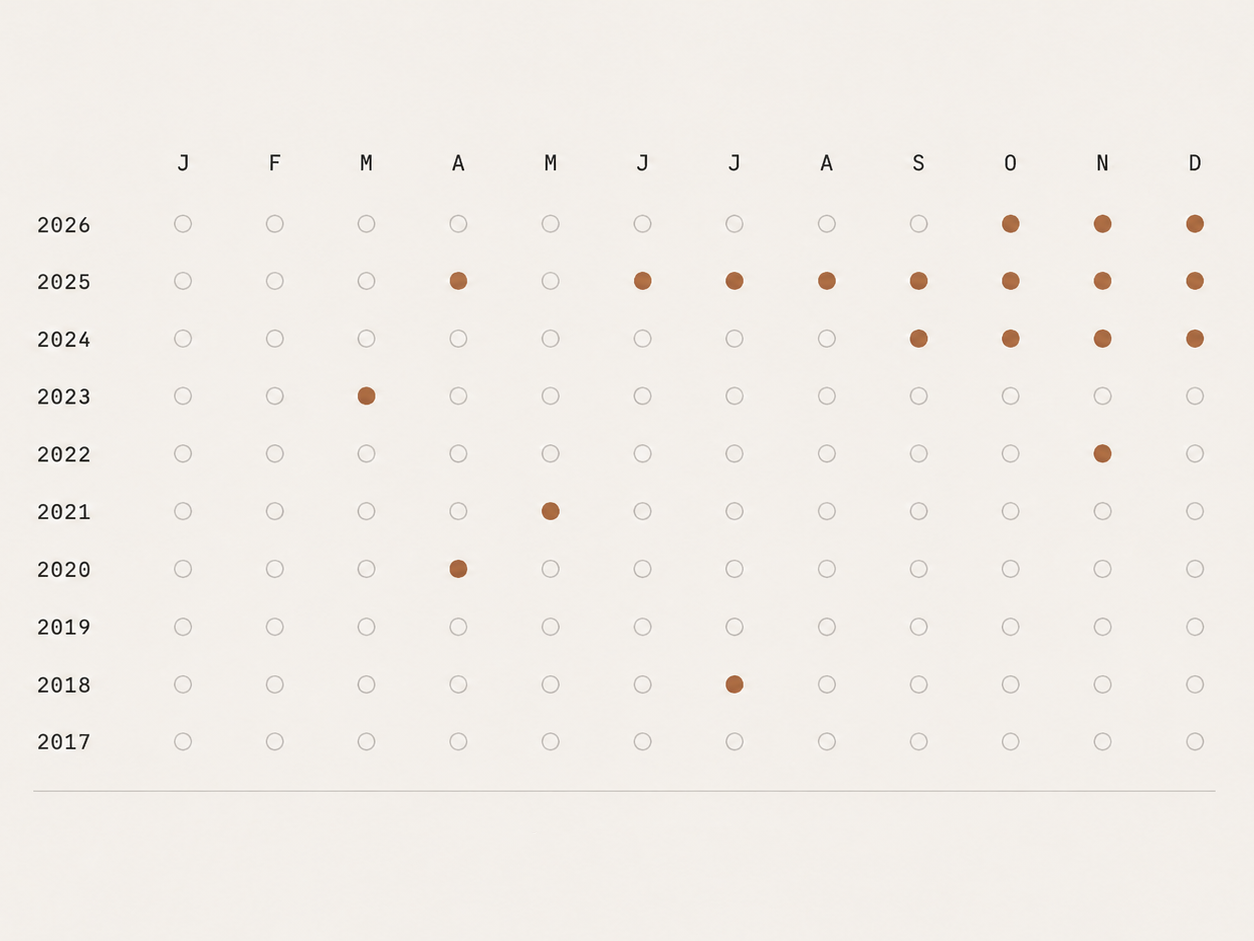
Once a month, you write down what you own and what you owe — and keep the series. It takes minutes. Over years, the line it draws is the one that answers the question.

The manifesto

I’ve been tracking my money for over 15 years. Not perfectly. Automated orders sometimes get entered three weeks late, and a few transactions slip through entirely. I correct what I can and move on. The data has never been complete. It has always been enough.

I don’t budget. Deciding in advance what I’m allowed to spend and then policing myself against it? I’ve never done that, and I hate the idea. I track. I record what actually happens and look at it. Guilt was never part of it. I simply like knowing where the money goes.

How long can I afford to live life on my terms?

Expenses only show what leaves. This question needed the whole position: cash, investments, debts. So I started writing down my net worth once a month.

Continue reading

The number itself matters less than the question it lets me ask. “Can I afford this?” stopped being interesting. What I ask now: is this moving me closer to freedom, or away from it?

Recently the answer was no. I was renting a second apartment. My net worth was still growing, but slower than it should have. So I gave the apartment up — not because I couldn’t pay for it, but because I could see, in numbers, that it was quietly shrinking the thing I actually care about: my options.

Optionality is the whole point. It means I can take a year off, can walk away from a client. Most of the doors I keep open I never walk through. Knowing they’re open changes how I stand in the room.

I still do. That’s all it is.

— Signed, the founder of Focused Capitalist

Two statements, one story

Every serious ledger has two statements. Consumer apps ship one.

Flows tell you the rate. Position tells you the reserve. Only both together tell you the duration.

Expense Hunter

Shipped
Asks
What is happening to my money?
Is
The income statement — flows, in and out.
Gives
Burn rate, and where it went.

Focused Capitalist

Opening now
Asks
Where do I stand — and for how long?
Is
The balance sheet — everything you own and owe.
Gives
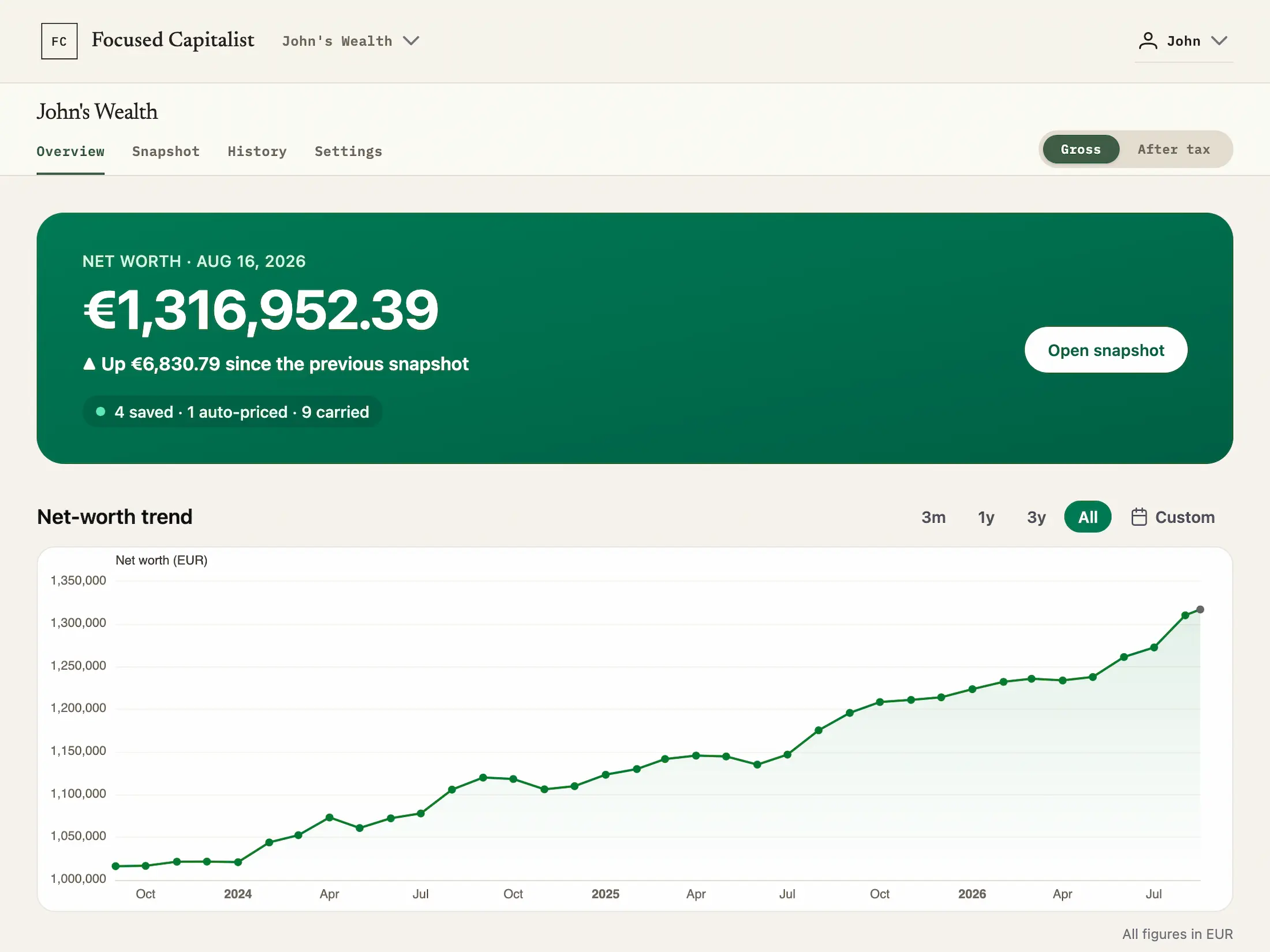
Net worth over time — a deliberate series.

Focused Capitalist opens today as a standalone net-worth tracker. The two are one story — you’re joining at the beginning of it.

What it actually does

You lay out everything you own and owe. Once a month, you write down what it’s worth.

A structure you build, not one you’re given.

Portfolio → sheets → nestable sections → positions. A spreadsheet’s freedom with a database’s memory. No imposed taxonomy — model your money the way you already think about it.

Dated snapshots, not a live balance.

You choose a date and enter what things were worth then. The dated history is the primary artefact — not a by-product of an app watching. A duration can only be read from a series.

Every row states its own honesty.

Each position tells you what kind of number you’re looking at. Stale and carried values are shown, not hidden. Incomplete is a legitimate state, not an error.

SavedAuto-pricedCarriedMissing

You enter only what you own.

For a market-priced holding, that’s the quantity — price and FX come from the server. For the apartment, the business share, the loan to a friend, it’s the value. Nothing you can look up is something you retype.

Everything counts, including what banks can’t see.

Cash, currencies, stocks, funds, bonds, crypto, metals, real estate, vehicles, private equity, businesses, liabilities — plus anything you name yourself. Multi-currency, one reporting currency, one net.

Focused Capitalist Family portfolio
Snapshot · 30 Jun 2026
Net position € 1,284,930 +4.8% in twelve months
PositionStatusValue
Cash & reservesSaved€ 94,400
Global equitiesAuto-priced€ 512,830
ApartmentCarried€ 735,000
MortgageSaved− € 57,300

Where it sits

Everyone else built a dashboard. This is a logbook.

A dashboard tells you the current reading. A logbook is what a series of readings becomes — and it’s the only artefact from which you can answer how long. Budgeting apps ask permission. Aggregators sell completeness and can’t see the illiquid half. We keep the series.

What it deliberately does not do

Stated plainly. Each is a boundary, not an apology.

  • No bank connections, no account aggregation. You enter the numbers.
  • No budgets, categories, limits, or alerts.
  • No advice, no recommendations, nothing sold on the other side of your data.
  • No return-chasing. No IRR, no benchmark, no “you underperformed.”
  • No real-time anything. Monthly is the intended cadence.
  • No leaderboard, no gamification, no streaks.

Who it’s for

You’ve kept records for years — usually in a spreadsheet you built yourself and privately like. You’re not in trouble and you’re not chasing returns. You own things banks can’t see: property, a stake in a company, crypto, metals. Often more than one currency. You’d switch off the spreadsheet only for something that isn’t dumber than the spreadsheet.

This is that. Not a budgeting app. Not a live-P&L trader tool. Not a dashboard that maintains itself while you stop reading it.

The long-term vision

On the horizon

Built to answer how long — not just how much.

Where the two products are headed: net worth ÷ burn rate = runway. And because every position carries a liquidity class, the same number splits into three different kinds of freedom. Not shipping at launch — it’s the star the roadmap steers toward.

Reachable today

“I could stop for 8 months without selling anything.”

immediate + short-term
This quarter

“…3 years if I sell the portfolio.”

+ market-liquid
Everything

“…11 years if I sell the apartment too.”

+ restricted + illiquid

Start the series.

Public registration is open. Ten minutes a month, and in a year you’ll have something no dashboard can give you: a line long enough to read.

Create your account

No card. No bank credentials, ever. You enter the numbers.